
 Last Shabbat, Rabbi Oded Mazor shared a powerful teaching with us about the plague of darkness that has stayed with me.
The Torah doesn’t just describe Egypt being plunged into darkness; it tells us something deeper — that in the darkness, people could not see one another. The verse reads:
לֹא רָאוּ אִישׁ אֶת אָחִיו
(lo ra’u eesh et acheev)— literally, one brother could not see the other.
That, Rabbi Oded taught, is the deepest darkness of all.
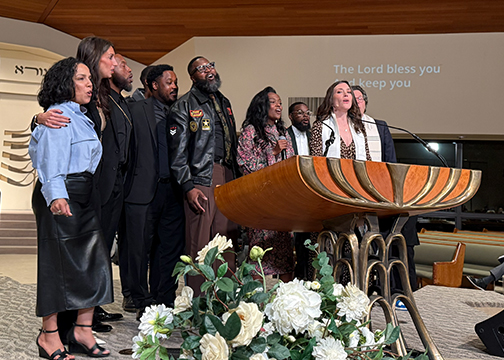
Last Sunday evening, we joined our dear friends at Greater Zion Church Family in Compton for a service of solidarity. I had the opportunity to share my reflections about our recent trip to Israel with my partners in organizing the experience, Bishop Michael Fisher of Greater Zion and Amanda Berman of Zioness. One of the central themes that emerged that evening came from Psalm 133, which opens with a verse many of us know well:
הִנֵּה מַה טּוֹב וּמַה נָּעִים שֶׁבֶת אַחִים גַּם יָחַד
(hiney mah tov u’ma naim, shevet achim gam yachad)— Behold how good it is, and how sweet, when brothers dwell together in unity.
That same word appears in both verses — אַחִים (achim), brothers.
The contrast struck me. Psalm 133 envisions a world illuminated by connection, where brothers and sisters truly see one another — and because of this, are able to dwell together.
The plague of darkness describes the opposite — a world where we lose sight of one another, where we fail to recognize one another’s humanity, where brother can no longer see brother.
That kind of darkness can take hold between communities, which is why nurturing relationships across religious and ethnic differences matters so deeply. Our relationship with our brothers and sisters in Compton is precious to us. It is a source of light. It reminds us what becomes possible when we refuse to turn away from one another.
 And if we can open our eyes and see our brothers and sisters just a few miles away in Compton, how can we close our eyes to what is unfolding in Minnesota? Many of us have been shaken by what we’re witnessing there. Federal immigration enforcement actions have gone far beyond reasonable, humane, and moral bounds. Communities are being terrorized. Families are living in fear. Children have been detained. And lives have been lost: Renee Good and Alex Pretti are dead. People who are otherwise law-abiding are being swept up in aggressive raids and treated as threats rather than as human beings. Make no mistake: Immigration reform is badly needed and our elected officials must take action. Removing violent criminals who pose genuine danger is justified and necessary. But terrorizing communities, detaining children, and using violence against people whose only offense is lacking legal documentation is unacceptable, un-American, and indefensible. We can do better. We must do better.
The path forward begins by remembering what darkness makes us forget: that we are brothers and sisters. That we are bound to one another. That we have obligations not only to those who look like us or worship like us, but to the stranger as well.
The Torah teaches us again and again, including in the parasha we will read just two weeks from now:
וְגֵ֖ר לֹ֣א תִלְחָ֑ץ וְאַתֶּ֗ם יְדַעְתֶּם֙ אֶת־נֶ֣פֶשׁ הַגֵּ֔ר כִּֽי־גֵרִ֥ים הֱיִיתֶ֖ם בְּאֶ֥רֶץ מִצְרָֽיִם׃
You shall not oppress a stranger, for you know the feelings of the stranger, having yourselves been strangers in the land of Egypt.
The stranger is also our brother and our sister. And we are accountable — to one another and to God — for how we choose to see them and most certainly for how we treat them.
May this Shabbat help us push back against the darkness. May it open our eyes to one another. And may it strengthen our resolve to live as achim — as brothers and sisters — walking together toward justice, dignity, and peace.
Shabbat Shalom,

Rabbi Yoshi