
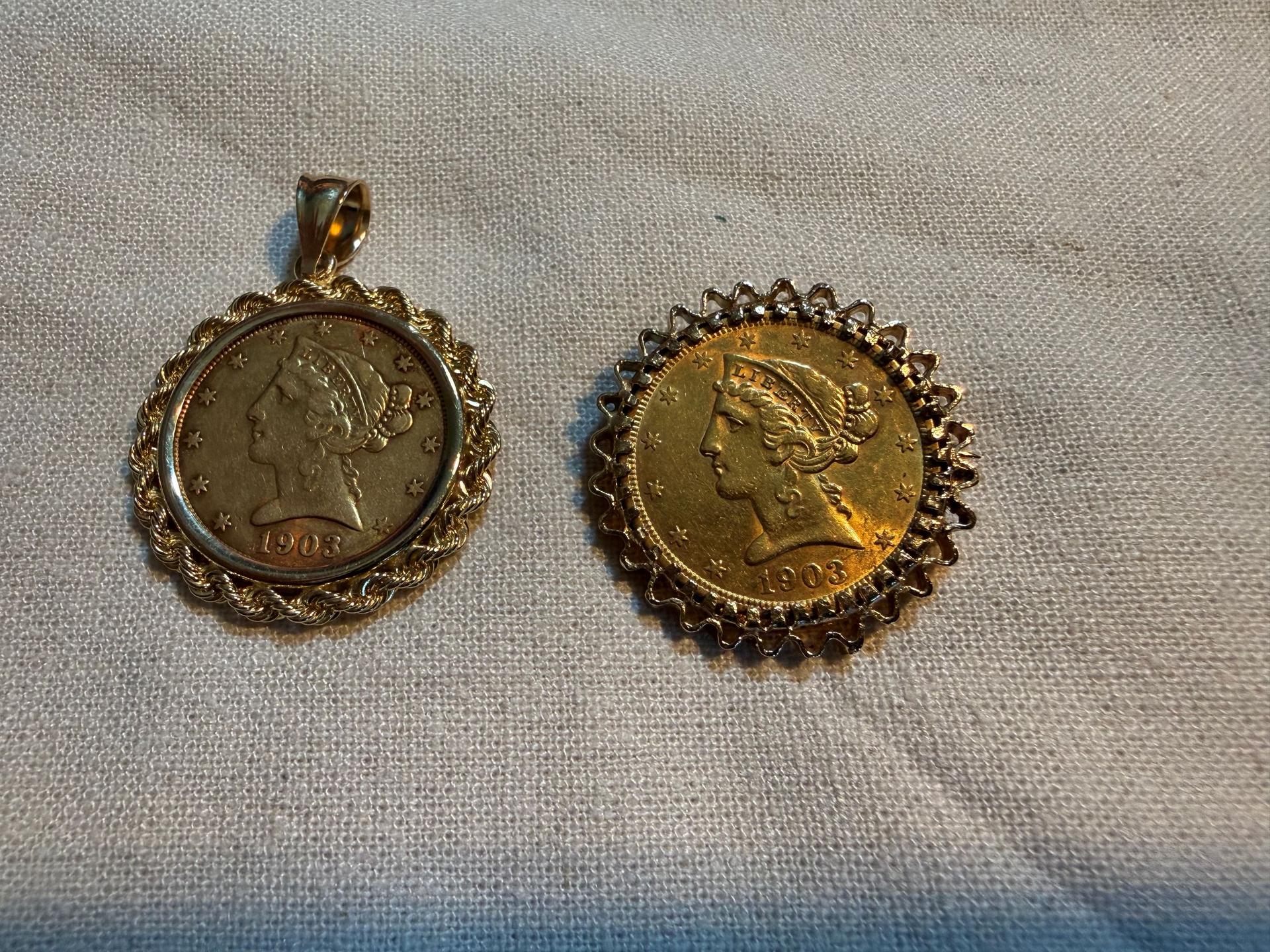
Recently we rediscovered a few items of jewelry that Becky’s parents left us. There were two 1903 gold nickels transformed into neck pendants, each encircled by a delicate gold filigree. Over 100 years old, clearly gold, valuable enough that they were turned into jewelry we thought maybe they should be insured. An internet AI search revealed that a 1903 nickel in mint condition was likely worth $4.50 and that gold nickels were never minted by the United States. Most likely, said our helpful AI platform, those items were gold plated. Which led to another question, why would Becky’s father, Aaron, have bothered to have two relatively worthless items (likely worth five cents at the time) coated in gold?
 Aaron Sobelman’s father was an immigrant from Poland who made a living as a housepainter. After the death of his first wife, he remarried Becky’s great-grandmother and she gave birth to Aaron who attended New York University and obtained a PhD in academic counseling. In his work, he proudly assumed the title of Doctor Sobelman.
When Becky was in her teens, Aaron compiled a family genealogy. He spent months requesting copies of birth certificates, ship manifests, immigration records, and other documents that could be used to piece together the story of one immigrant’s journey from their birthplace to the Golden Land.
Aaron was a proud American. He voted in every election, no matter how obscure, read the New York Times like it was a holy text, proclaimed his political independence, and declared that he voted for the candidate, not the party. He and Becky’s mom, Marilyn (born on July 4th) always belonged to a synagogue (attended regularly) and saw their membership as not only an expression of their connection to Judaism but most importantly as their American duty to support an institution that embodied the Constitution’s Second Amendment. Jewish-American or American-Jew – the order was unimportant to my in-laws. It was the existence of the overlapping and compound identities that was at the core of their deep American pride. The offspring of that Polish Jewish immigrant housepainter are fully American.
My grandparents were German Jews, but when their feet touched the shores of this nation, they discarded their Germanness like an old pair of shoes and became fully American – even if their accents always revealed their origins. My father and his brother barely learned a word of German—only English was spoken in their American home.
My grandsons, born of a Persian American mother, may only speak a few words of Farsi but they will always know that their Americanness is enriched by their Persian ancestry. We will tell them stories of the Sobelmans, the Sterns, and the Khorsandis—they will know where they come from and who they are.
Created 250 years ago by a founding generation that blended recent immigrants with a sprinkling of native born (though none truly indigenous), the American experiment endures. We are a country of immigrants who may express pride in their nations of origin, may even wave those colorful flags, but ultimately the greatest majority sublimate their Mexicanness, their Italianness, their Polishness, their Japan-ness to their Americanness. It is the regularly occurring miracle of this nation that it barely takes a generation for an identity born of a foreign land to become hyphenated and ultimately subordinated to the Star-Spangled Banner and its invitation to strive and achieve.
Last week, I looked out on the 100 or so children gathered for the second week of Wise Readers to Leaders. Many of them were the first generation born in this land. I took in the sight of the teachers/counselors enthusiastically inspiring the children to cheer and chant as their day of literacy enrichment began. Many of those dedicated college students or graduates, are not only the first in their families to be American born but the first to go to college. Both the children and the teachers were citizens because of their good fortune to be born on US soil. Like the Sobelmans, the Sterns, and the Khorsandis, they will go on to become productive citizens of this nation. I thought of Aaron’s gold-plated nickels and that was the moment I truly understood their value to him. They were emblematic of his belief in the American promise: if you have even the smallest fragment of hope in your pocket, in this country, you can turn it into gold.